Why Choose Shalako K | Veterinary Medicine for Chiropractic Care?
At Shalako K | Veterinary Medicine, chiropractic care is an important part of our integrative approach to veterinary medicine. Dr. Kaci Merk combines advanced chiropractic training with evidence-based Western medicine and complementary therapies to help improve comfort, mobility, and overall function for a variety of animal species.
After earning her Doctor of Veterinary Medicine degree, Dr. Kaci completed more than 210 hours of specialized training through Options for Animals College of Animal Chiropractic, the only chiropractic program in the United States recognized by the International Veterinary Chiropractic Association (IVCA). This advanced education allows her to safely evaluate and treat neuromusculoskeletal conditions using veterinary chiropractic techniques tailored to each patient.
In addition to chiropractic care, Dr. Kaci is also certified in veterinary acupuncture through the International Veterinary Acupuncture Society (IVAS). By integrating chiropractic care, acupuncture, rehabilitation, laser therapy, and Western veterinary medicine, she develops personalized treatment plans that address each patient’s unique needs and support long-term health and wellness.
Supporting Comfort, Mobility, and Healing Without Surgery
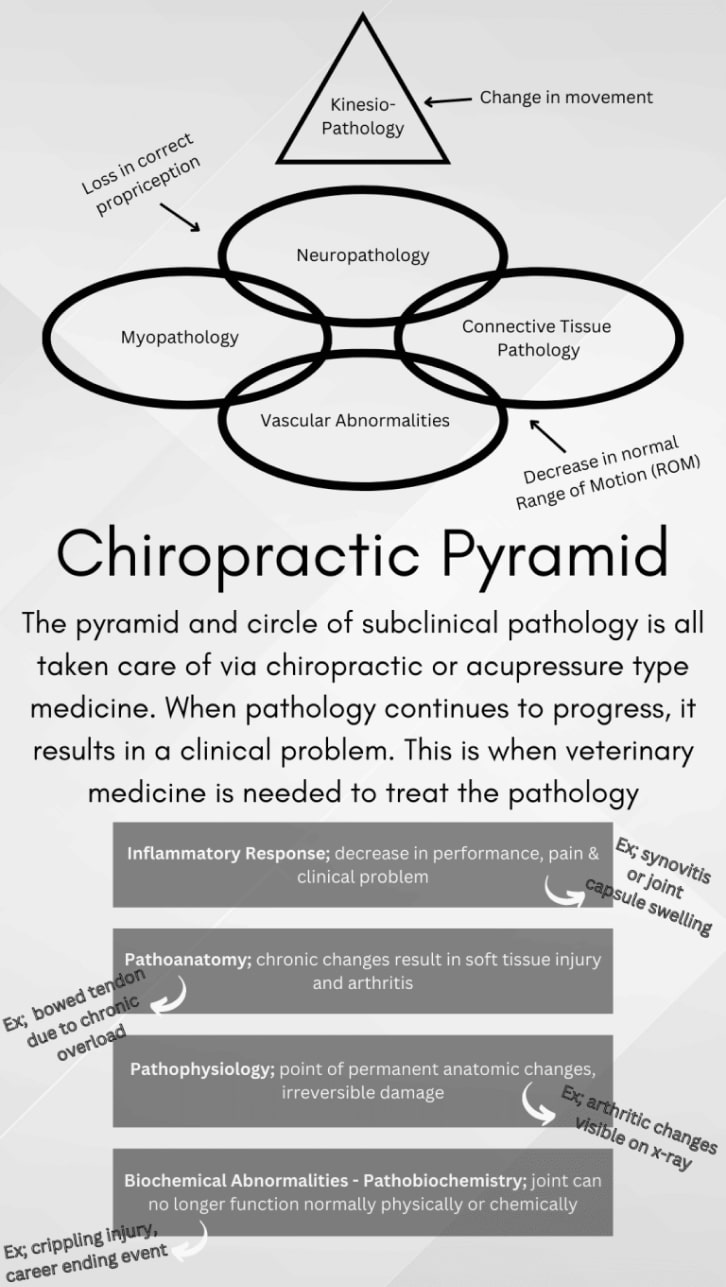
IVCA-certified veterinary chiropractic care focuses on restoring proper movement within the spine and joints to support healthy nervous system function and improve overall mobility. As part of an integrative treatment plan, chiropractic care may help reduce discomfort, improve flexibility, support recovery from injury, and enhance quality of life without relying solely on medications or surgery.
The Benefits of Veterinary Chiropractic Care
Veterinary chiropractic care complements traditional veterinary medicine by addressing biomechanical dysfunction that may contribute to pain, reduced mobility, or decreased performance. Rather than replacing conventional medical care, it works alongside other therapies to provide a more comprehensive approach to patient health.
Depending on the individual patient, chiropractic care may help:
-
Improve mobility and flexibility
-
Reduce musculoskeletal discomfort
-
Support recovery following injury or illness
-
Enhance balance, coordination, and movement
-
Promote overall health and quality of life
Why does veterinary chiropractic care require a veterinarian?
Texas law regulates who may perform animal chiropractic and other forms of Musculoskeletal Manipulation (MSM) to help protect animal health and safety. Before treatment can begin, a veterinarian must establish a valid veterinarian-client-patient relationship (VCPR), perform an examination to determine whether chiropractic care is appropriate, and obtain the owner’s signed acknowledgment that chiropractic care is considered an alternative therapy under Texas law.
In certain situations, a trained non-veterinarian may perform these procedures only under the direct or general supervision of a licensed veterinarian after all legal requirements have been met.
For the complete regulations regarding animal chiropractic and Musculoskeletal Manipulation (MSM), please refer to the Texas Administrative Code.
(1) A licensed veterinarian. Animal chiropractic and MSM may be performed by a licensed veterinarian under the following conditions:
According to the Texas State Board of Medical Examiners, Texas Administration Code Title 22 Part 24 Chapter 573 Subchapter B Rule 573.14; Chiropractic care or other forms of Musculoskeletal Manipulation (MSM) can only be performed under the following conditions;
(A) a valid veterinarian-client-patient relationship has been established as defined in the Act;
(B) an examination has been made by the licensee to determine that animal chiropractic/MSM will not likely be harmful to the patient; and
(C) the licensee obtains as a part of the patient’s permanent record a signed acknowledgment by the owner or other caretaker of the patient that animal chiropractic or MSM is considered by Texas law to be an alternate therapy.
(2) A non-veterinarian employee or an independent contractor. A non-veterinarian employee or an independent contractor may perform these procedures on an animal under the direct or general supervision of the veterinarian if the conditions in paragraph (1)(A) – (C) of this subsection have been met.
The full subsection can be found here and contains the full legal ramifications of performing MSM on animals.